
Jane Goodall (1934–2025)
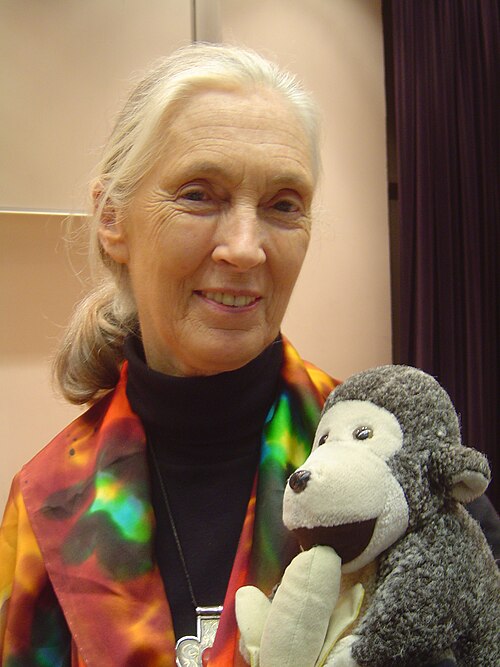
Jane Goodall, who died on 1 October 2025 aged 91, transformed the scientific study of primates and the ways in which people around the world understand relationships between humans and other animals. Her observations of wild chimpanzees at Gombe challenged supposedly defining boundaries between humans and other species; her attention to individual animals helped reshape the study of animal behaviour; and her extraordinary ability to communicate inspired generations of primatologists, conservationists and members of the public.
Valerie Jane Morris-Goodall was born in London on 3 April 1934 and grew up in Bournemouth. In 1957 she travelled to Kenya, where an introduction to the palaeoanthropologist Louis Leakey proved decisive for her scientific career. Leakey employed her and became an influential patron, securing support for the research on wild chimpanzees (Pan troglodytes) that she began at Gombe Stream on Lake Tanganyika, located in present-day Tanzania, in 1960. She arrived in July that year, aged 26, without an undergraduate degree or formal scientific training.
Most famously, Goodall watched chimpanzees modify and use plant stems to extract termites from their mounds, at a time when tool manufacture and use were widely regarded as unique to humans. She gave chimpanzees names, including David Greybeard, Flo and Fifi, and recorded individual personalities, relationships and life histories. Her practice of following recognisable individuals across their lives laid the foundations for a long-term record that would reveal patterns invisible to shorter studies.
Goodall was not alone in developing an individual-centred approach to primate behaviour. In Japan, Kinji Imanishi, Junichiro Itani and colleagues had pioneered the study of individually identified macaques and their social relationships from 1948. This independent tradition extended to chimpanzees at Mahale, further south along Lake Tanganyika from Gombe, where Toshisada Nishida began research in 1965, five years after Goodall began her work (Nishida 1968; Wilson 2021).
When Goodall went to Newnham College, Cambridge in 1962 to undertake a doctorate in ethology, her approach met a different scientific culture. She later recalled senior scientists objecting to her attribution of personalities, emotions and minds to chimpanzees. She credited her supervisor, the zoologist Robert Hinde for bringing greater methodological rigour to her research and teaching her to think critically (Goodall 2017). But the intellectual influence ran in both directions. Donna Haraway (1989) identifies Goodall, alongside the biologist and primatologist Thelma Rowell, as important in shifting Hinde’s thinking towards the complexity and individuality of primate behaviour. Hinde himself later acknowledged the influence of Goodall and Dian Fossey, saying that they had taught him to see animals as individuals rather than simply members of a species (Hinde 2008).
As the years of observation at Gombe accumulated, they also challenged Goodall’s own understanding of chimpanzees. During the 1970s she documented infanticide and cannibalism and what she called the Four-Year War, which followed the division of the study population into the Kasekela and Kahama communities. Kasekela males repeatedly entered Kahama territory and attacked members of the smaller community, which eventually disappeared (Goodall 1986).
Haraway (1989) examined how Goodall became not only a scientist but a powerful cultural figure: the young white woman apparently alone with chimpanzees in an African forest. National Geographic helped create and circulate that image, which Goodall herself later recognised as a romanticised version of her life (Gerber 2017). It was enormously powerful and remained central to the public presentation of her work but could obscure the many other people through whose work Gombe’s long-term record became possible.
Goodall began her research in Tanganyika under British colonial rule. Research at Gombe was a collaborative undertaking from the outset, although it is often portrayed as the achievement of a lone young woman. Goodall arrived with her mother Vanne, whose presence was required by the British authorities, accompanied by David Anstey, a game ranger in the British colonial administration. They were greeted by the honorary headman of Kasakela village, Iddi Matata. Dominic, who had been hired as cook, and his wife and daughter, whose names Goodall does not record in her account, were also part of the small party. Goodall worked with African game scouts, identified as Adolf, Saulo David and Marcel, and a boatman, Hassan (Goodall 1971). As the project developed into a major international research enterprise, generations of Tanzanian field researchers sustained the extraordinary longitudinal record on which much of Gombe’s science depends, working alongside researchers from many other countries. Following the kidnapping of four foreign researchers in 1975, Tanzanian researchers maintained the continuity of fieldwork when restrictions prevented foreign researchers from working at Gombe. They also increasingly took on leadership roles: Shadrack Kamenya and Deus Mjungu both earned doctorates through research at Gombe and subsequently served as directors of the project (Wilson et al. 2020).
The long duration and close observation that made Gombe scientifically extraordinary also brought consequences for the chimpanzees themselves. Provisioning altered their behaviour, while habituation and sustained proximity to humans brought risks including infectious disease (Wilson et al. 2020). Goodall founded the Jane Goodall Institute in 1977, initially to support research at Gombe. A decisive change in her life came at the 1986 Understanding Chimpanzees conference in Chicago. Confronted both by evidence of habitat destruction and declining chimpanzee populations across Africa and by the treatment of chimpanzees in captivity, particularly in biomedical laboratories, Goodall later recalled that she arrived as a scientist and left as an activist (Goodall 2014). Her subsequent travels also convinced her that chimpanzee conservation could not be separated from the circumstances of people living in and around chimpanzee habitat (Goodall 2021). In 1991 she founded Roots & Shoots, an environmental and humanitarian youth programme that began with 12 Tanzanian high-school students in Dar es Salaam and developed into a global movement concerned with people, other animals and the environment.
Goodall’s scientific synthesis, The Chimpanzees of Gombe (1986), sat alongside an extensive body of writing for wider audiences, including In the Shadow of Man (1971), Through a Window (1990), Reason for Hope (1999), and books for children. Through her books, films, lectures and television programmes, she brought chimpanzees as individuals with complex social lives to generations of people around the world. Goodall inspired generations of primatologists, myself included. Her many international honours included the Kyoto Prize in Basic Sciences in 1990, appointment as DBE in 2004, the Templeton Prize in 2021 and the US Presidential Medal of Freedom in 2025. She received the Royal Anthropological Institute’s Huxley Memorial Medal in 2002. The lecture ‘The Scientific Study of Primates and its Impact on Contemporary World-Views’ which she gave to mark the latter captured the wider significance of her research.
Goodall’s importance to anthropology lies ultimately in the questions her life’s work raised about boundaries: between humans and other animals, observer and observed, and individual achievement and collective knowledge. Gombe showed what could be learned by following particular animals across generations; its history also reminds us that such knowledge is made by particular people, within particular institutions and histories. That more complicated history belongs alongside, rather than in opposition to, Goodall’s extraordinary influence.
In changing how we understood chimpanzees, Jane Goodall changed anthropology’s understanding of what it means to be human.
Jane Goodall, ethologist and conservationist, born London, 3 April 1934; died Los Angeles, 1 October 2025. She is survived by her son, Hugo Eric Louis van Lawick, her grandchildren Merlin, Angel and Nick, and her sister Judy Waters.
References
Gerber, T. 2017. How Jane Goodall changed what we know about chimps. National Geographic, October 2017. https://www.nationalgeographic.com/magazine/article/becoming-jane-goodall
Goodall, J. 1971. In the Shadow of Man. London: Collins.
Goodall, J. 1986. The Chimpanzees of Gombe: Patterns of Behavior. Cambridge, MA: Belknap Press of Harvard University Press.
Goodall, J. 1990. Through a Window: My Thirty Years with the Chimpanzees of Gombe. London: Weidenfeld & Nicolson.
Goodall, J. 2014. Interview with Jennifer Byrne. Jennifer Byrne Presents: Jane Goodall. ABC Television. https://www.abc.net.au/tv/firsttuesday/s4080363.htm (accessed 7 October 2026).
Goodall, J. 2017. Remembering my mentor: Robert Hinde. Jane Goodall Institute. https://janegoodall.org/news/remembering-my-mentor-robert-hinde/ (accessed 7 October 2026).
Goodall, J. & P. Berman. 1999. Reason for Hope: A Spiritual Journey. New York: Warner Books.
Goodall, J. 2021. Jane Goodall on a life as a woman defending the wild. Chatham House, 23 November. https://www.chathamhouse.org/2021/11/jane-goodall-life-woman-defending-wild (accessed 7 October 2026).
Haraway, D.J. 1989. Primate Visions: Gender, Race, and Nature in the World of Modern Science. New York: Routledge.
Hinde, R.A. (2008). Interview of Robert Hinde. Apollo – University of Cambridge Repository. http://www.dspace.cam.ac.uk/handle/1810/195207 [Accessed 7 October 2026].
Nishida, T. 1968. The social group of wild chimpanzees in the Mahali Mountains. Primates 9: 167–224.
Wilson, M.L. 2021. Insights into human evolution from 60 years of research on chimpanzees at Gombe. Evolutionary Human Sciences 3: e8. doi:10.1017/ehs.2021.2.
Wilson, M.L., E.V. Lonsdorf, D.C. Mjungu, S. Kamenya, E.W. Kimaro, D.A. Collins, T.R. Gillespie, D.A. Travis, I. Lipende, D. Mwacha, S.A. Ndimuligo, L. Pintea, J. Raphael, E.R. Mtiti, B.H. Hahn, A.E. Pusey & J. Goodall. 2020. Research and conservation in the Greater Gombe Ecosystem: challenges and opportunities. Biological Conservation 252: 108853. doi:10.1016/j.biocon.2020.108853.
By Joanna M. Setchell
Department of Anthropology, Durham University