
10 May 1946 – 24 March 2026
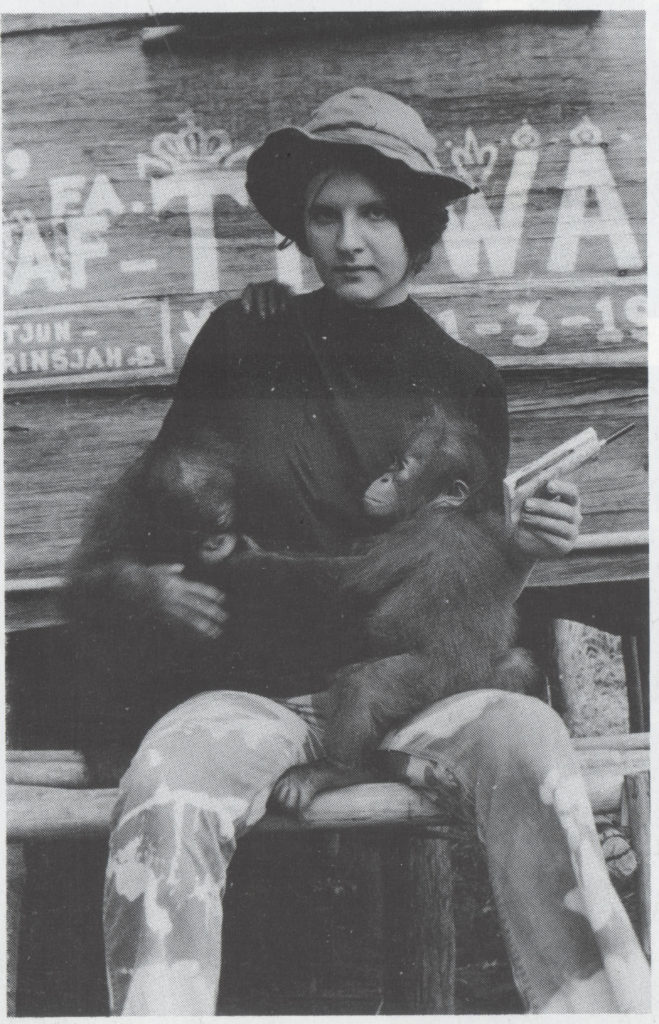
Birutė Marija Filomena Galdikas, the world’s foremost authority on orangutans, died aged 79 on 24th March 2026 in the University College of Los Angeles Hospital, from lung cancer and pulmonary fibrosis. She taught for over 40 years at the Department of Archaeology, Simon Fraser University, Canada, where in 1989, she became the first woman appointed full professor. Since 1979, she served as Professor Extraordinaire with Universitas Nasional, Indonesia.
Galdikas’ published twenty-six peer-reviewed journal articles, mostly between the late 1970s, and 1990s, alongside four books, and two landmark National Geographic cover stories. Critics sometimes questioned the scale of her output relative to her time in the field, but Birutė maintained that conservation action took precedence. Her most cited paper, from 1988 gave the first comprehensive account of orangutan diet, ranging, and activity in Tanjung Puting national park, Indonesia; a 1990 paper established interbirth interval data still foundational to orangutan conservation biology. She is survived by her three children; Binti, Frederick and Jane from her marriages to Rod Brindamour and Dayak leader Pak Bohap bin Jalan; her sister, Aldona Galdikas-Franz; and seven grandchildren.
Birutė’s honours included the Guggenheim Fellowship (1983), PETA Humanitarian Award (1990), Officer of the Order of Canada (1995), the Tyler Prize for Environmental Achievement (1997, which she shared with Jane Goodall and George Schaller), and the Indonesian Kalpataru Award (Hero for the Earth) (1997), the first time this award was awarded to someone born outside of Indonesia. In April 2025, despite her frail condition and ongoing medical treatment, Birutė was awarded The Explorers Club Medal for her extraordinary contribution to science: a source of pride and honor for Indonesia. She had established the Orangutan Research and Conservation Project (ORCP) with her first husband, Rod Brindamour, on arriving in Tanjung Puting in 1971; as the project drew international media attention, the Orangutan Foundation (later becoming Orangutan Foundation International), founded in 1986 with Dr Gary Shapiro and the support of US lawyer John Beal, allowed the work at Camp Leakey to expand, and sister organisations followed in Indonesia, the UK, Australia, and Canada. Following her death; her son Frederick succeeds her as OFI President.
Born in Wiesbaden to Lithuanian refugees, Antanas and Filomena, Galdikas grew up in Toronto before emigrating to the United States, and completed a bachelor’s and master’s at UCLA, where she approached the British-Kenya palaeoanthropologist Louis Leakey, already patron to Jane Goodall and Dian Fossey’s studies of chimpanzees and gorillas. After years of persistence, she departed in 1971, aged 25, for Tanjung Puting Reserve in Borneo, naming her camp after her mentor. With no roads, telephones, or electricity, she remained in the remote village of Pasir Panjang for over half a century; research continues there today under her former students.
Almost immediately upon her arrival in Borneo, Birutė began rescuing and rehabilitating wild-born orangutans caught in the pet trade, work she considered equally as important as science. With no existing guidelines for primate rehabilitation, Birutė improvised, and quickly became known as a mother figure (‘ibu’ in the local Indonesian language) to the orphaned orangutans to her care. A persona amplified by her 1975 and 1980 National Geographic covers, which were instrumental in bringing Galdikas and her work into global public consciousness. As Dr Ian Singleton OBE put it: “When Birutė first went to Borneo, nobody in the West had any idea what an orangutan was. She put orangutans on the map.”
Her early findings were foundational: in contrast to the African apes, she described a largely solitary animal with an unrivalled system of infant care. She documented the slowest interbirth interval of any mammal, once every 7.7 years and was the first to record the orangutan diet, social organisation, male ‘long-call’ and bimaturism. Her doctoral dissertation, completed at UCLA in 1978, firmly established her as the leading figure in orangutan science and her first peer-reviewed publication that same year, officially announced a career combining meticulous field observations with a ferocious commitment to conservation.
Of the three women selected by Louis Leakey to undertake long-term studies of wild great apes, known widely as the ‘Trimates’, Galdikas alongside Jane Goodall and Dian Fossey was the most academically qualified but least publicly celebrated, despite her most sustained presence in the field. Goodall and Fossey were celebrated by award-winning films; while recognition for Galdikas came slower and never on the same scale. As Ashley Leiman OBE Director of the Orangutan Foundation, UK put it, ‘her persistence, in conditions her colleagues elsewhere never faced, is a distinguishing feature of her character and career that she has not always been adequately recognised for’.
Her life was not without controversy: her rehabilitation approach was criticized as incompatible with successful reintroduction, so the practice of reintroduction at Tanjung Puting was eventually discontinued as guidelines evolved, moving to rehabilitation to the separate Orangutan Care Centre in the 1990’s. Gary Shapiro, OFI’s co-Director for eighteen years, described her as ‘complex, but resolute in her championing for orangutans and Tanjung Puting National Park’, adding: “She inspired tremendous loyalty and expected it in return.” A characterisation offered with upmost respect and admiration. Her tenacity is likely what drove such a long and influential life.
Galdikas’s work was inseparable from the communities around Tanjung Puting. She learned local languages, assimilated with Dayak culture and served as Senior Advisor to the Minister of Forestry between 1996 to 1998. From 1974, she mentored over a hundred Indonesian researchers and students, and her promotion of tourism at Camp Leakey created new livelihoods for many local guides and tour operators.
Birutė loved Central Kalimantan and the Dayak culture, especially karungut music which she would play on repeat on long car journeys. Birutė became an Indonesian citizen in 1994; and she was buried, at her own request, according to Dayak custom beside her husband of 41-years at their home in Pasir Panjang. Despite hardships, challenges and threats, her commitment and generosity to others throughout her life was unwavering. At her funeral, her son Frederick reflected that her principle ‘be sincere, straight and steadfast’, continues to guide him, and he imagined that her final wish would be ‘to care about the world and about others, and to act based on that care’.
The Indonesian people who lived and worked alongside Birutė believed she had a profound understanding of the spirit of orangutans and the forest. Ruth Linsky (President of OFI-Canada) said that “OFI colleagues from around the world, students, and those who worked closely, with her agree that she perhaps understood the minds and hearts of orangutans better than anyone else. This understanding was forged through decades of scholarly observation of over three generations of wild orangutans and motherly attention to the over 1000 orangutans she helped rescue, care for, and return to the wild.” Her legacy will live on within each person she inspired and, in the forests, and animals she helped to protect. Her passing has left a particular silence over Central Kalimantan, and over the students and field staff whose careers she shaped. The loss of Ibu Birutė will be felt profoundly for many years to come.
Dr Andrea L. Permana (University of Warwick)
Selected Publications:
Galdikas, B.M.F. (1978). Orangutan death and scavenging by pigs. Science, 200, 68–70.
Galdikas, B.M.F. (1988). Orangutan diet, range, and activity at Tanjung Puting, Central Borneo. International Journal of Primatology, 9(1), 1–35.
Galdikas, B.M.F. and Wood, J.W. (1990). Birth spacing patterns in humans and apes. American Journal of Physical Anthropology, 83(2), 185–191.
Books:
Galdikas, B.M.F., Reflections of Eden: My Years with the Orangutans of Borneo (Little, Brown and Company, 1995)
Galdikas, B.M.F. and Briggs, N., Orangutan Odyssey (Harry N. Abrams, 1999)
Galdikas, B.M.F., Great Ape Odyssey (Harry N. Abrams, 2005)
Galdikas, B.M.F., Briggs, N.E., Sheeran, L.K., Shapiro, G.L., and Goodall, J. (eds),
All Apes Great and Small (Kluwer Academic, 2001)
Galdikas, B.M.F., PhD dissertation: Orangutan Adaptation at Tanjung Puting Reserve, Central Borneo (UCLA, 1978).
Note: article count is drawn from Web of Science (Core Collection), accessed July 2026.