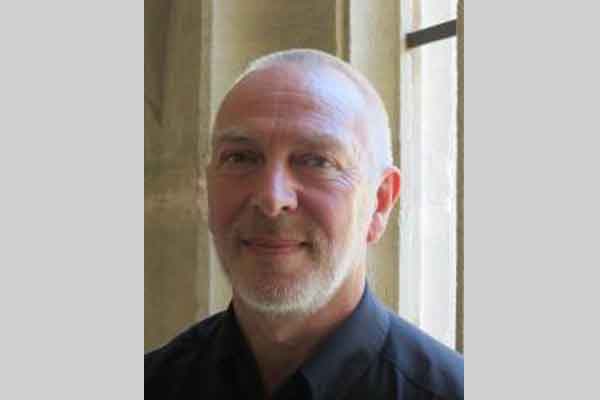
Marcus Banks (1960-2020)
The tragic and untimely death of Marcus Banks, Professor of Visual Anthropology at the University of Oxford, is a deep loss for the many anthropological communities of which he was a valued and committed member. European anthropology, British anthropology, Visual anthropology, South Asian anthropology and Oxford anthropology: all are mourning.
Marcus studied social anthropology at Cambridge as an undergraduate and research postgraduate. His 1986 PhD was entitled “On the Srawacs or Jains: processes of division and cohesion among two Jain communities in India and England”. The following year he took up a temporary ‘demonstrator’ post at the Oxford Institute of Social and Cultural Anthropology. He remained in Oxford for the rest of his academic career.
Many of us will remember being inspired by his undergraduate lectures – whether on ethnicity, visual anthropology or fieldwork. They were masterful and accessible reviews of each field. Marcus would take us far beyond the discipline, offering capacious insights on contemporary theoretical debates, full of insightful gems but wary of imposing his own perspectives.
Marcus saw the importance of all students gaining practical fieldwork experience, and during the 1990s he developed a range of pioneering courses in research methods. He was deeply committed to his supervisees, and heavily involved in supporting innovations in doctoral training across the UK. In Oxford he helped launch the Visual Anthropology Masters degree. Closely interested in the technologies of visuality, both old and new, Marcus was ever curious, always learning new skills and engaging new debates.
Marcus had a strong sense of the scholarly virtues that should inform university administration. He embodied and exemplified fairness, balance, and calm reflection. He was endlessly generous with his time, and took on a huge range of service commitments. Along with his long-standing work for the RAI Film Committee, he was an Oxford University Proctor, and held leadership roles at Wolfson College and as Head of Department. He also made many contributions to European anthropology and to visual anthropology. Marcus was a valued member of EASA’s Executive Committee from 2017-19 and had been an EASA member since the early 2000s.
Marcus may have been a talented visual anthropologist with a rich diversity of research interests and administrative talents, but he will be most remembered for his generosity, kindness and compassion. He cared genuinely about the discipline, but much more about the wellbeing of his students, colleagues and everyone he worked with.
His scholarly modesty is captured in his 10 word facebook biography: “I teach and research in social anthropology and visual anthropology”. There is so much more to say. We remember Marcus as a scholar, a colleague, and a humanist. RIP.
By David Mills
My academic mentor and friend Marcus Banks, who has died aged 60 of epilepsy, was a social anthropologist. He played a leading role in promoting the sub-discipline of visual anthropology, which is concerned with studying cultures through photography, film and other media.
Spending his entire career at Oxford University, from the late 1980s onwards Marcus showed how visual artefacts should be thought of as a central – perhaps the central – means through which all people, everywhere, forge their identities, and through which they order and transform the worlds around them.
Born in Liverpool to Jack Banks, a chemistry lecturer at a further education college, and his wife, Nan (nee Holt), Marcus went to New Heys Comprehensive school in Liverpool and then, in 1978, to Christ’s College, Cambridge. He gained a first class degree in social anthropology and stayed on for a PhD, completing his thesis there in 1985.
He went on to study film-making at the National Film and Television School in Beaconsfield, Buckinghmashire, before being appointed a lecturer at the Institute of Social and Cultural Anthropology in Oxford (1987). He remained at the department for the rest of his life, later becoming professor (2001) and director of the university’s larger School of Anthropology and Museum of Ethnography (2012-2016).
He held visiting professorships at the universities of Vienna (2010), Paris Descartes (2011) and Canterbury, New Zealand (2012), and sat on the Royal Anthropological Institute’s film committee (2001 onwards) and the European Association of Social Anthropologists’ executive committee (2017-19).
Marcus’s partner for more than 30 years was Barrie Thomas, whom he had met while walking around the University Parks in Oxford. They repeated that same walking route through the Parks innumerable times, and in all seasons.
Marcus is survived by Barrie, his brother, Martin, and his niece, Tessa.
By The Guardian