

This virtual launch is co-organized with the Archaeology and Gender in Europe (AGE) Network of the European Association of Archaeologists.
Tuesday 14 April 2026, 4-6pm (BST)
To join on Zoom, please register here: https://us02web.zoom.us/webinar/register/WN_AIj41HC-Q-uN5dyYFK9VrA#/registration
Kinship Trouble:
Traversing Interdisciplinary Boundaries between
Archaeology, Archaeogenetics and Socio-cultural Anthropology
Speakers:
Sabina Cveček (Field Museum of Natural History, Austrian Academy of Sciences)
Maanasa Raghavan (University of Chicago)
Penny Bickle (University of York)
Alex Bentley (University of Tennessee)
Krystal Tsosie (Arizona State University)
Sandra Bamford (University of Toronto)
Emma Kowal (Deakin University)
What is “kinship trouble”? When and where did it emerge, and why does it matter now? This virtual launch introduces an interdisciplinary special issue of the Cambridge Archaeological Journal that places these questions at the center of contemporary debate. Kinship Trouble: Traversing Interdisciplinary Boundaries between Archaeology, Archaeogenetics and Socio-cultural Anthropology, co-edited by Sabina Cveček, Maanasa Raghavan, and Penny Bickle, brings together leading socio-cultural anthropologists, archaeologists, biological anthropologists, and ancient DNA scientists to address the conceptual, methodological, and ethical challenges of reconstructing past kin relations. The term kinship trouble captures both the tensions sparked by recent archaeogenetic breakthroughs and the limits of reducing kinship to biological relatedness, while also opening space to rethink kinship as a social, relational, and ethical phenomenon. Developed from interdisciplinary sessions at the American Anthropological Association (Toronto 2024) and the Archaeological Institute of America (Chicago 2025), the issue models sustained dialogue across fields that do not always share the same conceptual language by grounding the discussion in theoretical underpinnings and multi-regional case studies from the constituent fields. The virtual launch will offer an accessible overview of its central themes: ethical collaboration, integrating biological and social approaches, and understanding kinship as an act of care and (non)mutuality of being. Scholars across anthropology, archaeology, and the life sciences are warmly invited to join this conversation about how we study relatedness and why it matters for understanding human diversity past and present.
Other contributing authors:
Carlos Eduardo G. Amorim (Arizona State University), Catherine Frieman (Australian National University), Andre Gingrich (Austrian Academy of Sciences), Anna Mercedes Herrero Coral (University of Valladolid), Tim Ingold (University of Aberdeen), Alissa Mittnik (Max Planck Institute for Evolutionary Anthropology), Hannah Moots (Centre for Paleogenetics), Jennifer Raff (The University of Kansas), Beth K. Scaffidi (University of California, Merced), Caroline Schuster (Australian National University), Mehmet Somel (Middle Eastern Technical University), Peter Whiteley (American Museum of Natural History), Rosemary Joyce (University of California, Berkley)
Find the Special Issue here as open access:
https://www.cambridge.org/core/journals/cambridge-archaeological-journal/latest-issue
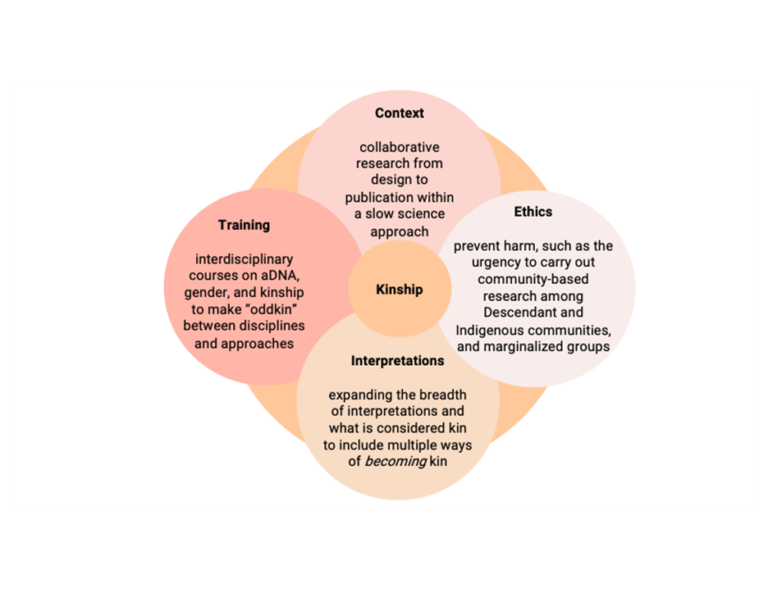
Illustration caption: Four ways forward to address the kinship trouble through ethics, training, contexts, and interpretations (Cveček, Raghavan, and Bickle 2026, Fig. 3).