
Michael Thompson (1937–2026)
Michael Thompson, who died on 17 March 2026 at the age of eighty-nine, was among the most intellectually original figures to emerge in British anthropology in the post-war period. His ideas have shaped scholarship in risk studies, environmental governance, energy policy and financial regulation, and he is today among the most cited social scientists in the world. Yet within his own discipline he remains less well known than his achievements warrant. His death should serve as an occasion to put this right.
Thompson was born in Cumbria in northern England, on 28 January 1937 and began his studies at the Royal Military Academy Sandhurst, before serving as an officer with the 1st Queen’s Dragoon Guards during the final phase of the Malayan Emergency (1945–1960). He then turned to mountaineering, joining Chris Bonington’s Annapurna South Face expedition in 1970, and the successful Everest South-West Face expedition in 1975 – two of the most challenging climbs ever attempted. These experiences, satirised in ‘Out with the Boys Again’ (1978), fed directly into his later thinking on risk and emergent collective behaviour, developed in ‘Why Climb Everest? A Critique of Risk Assessment’ (1983).
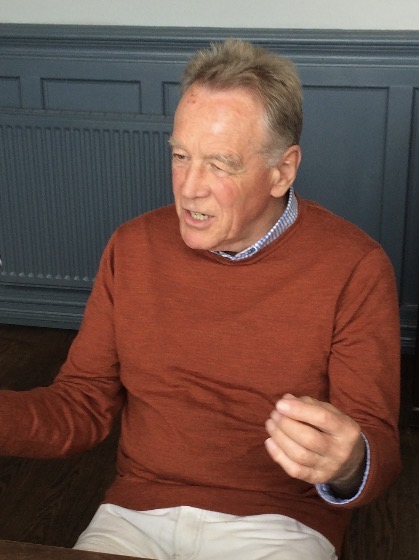
Thompson came to anthropology in his mid-twenties, taking a BSc at UCL (1962–65) and then a BLitt in Social Anthropology at Corpus Christi College, Oxford (1965–68). Before completing his PhD at UCL in 1976, where he was supervised by Mary Douglas and the mathematician E. C. Zeeman. He taught urban sociology at the School of Architecture in Portsmouth and the Slade School of Fine Art, London. He then held fellowships at MIT and the Wissenschaftszentrum Berlin and conducted fieldwork in his beloved Nepal while under contract with the Russell Sage Foundation. He subsequently held positions at the International Institute for Applied Systems Analysis (IIASA) in Laxenburg (1980–85) and the University of Warwick (1985–87), before joining the University of Bergen as Professor II (a part-time adjunct chair) (1995–2003). He remained affiliated with both IIASA and the Institute for Science, Innovation and Society at the University of Oxford until his death.
From 1987, Thompson also ran his own consultancy, the Musgrave Institute in London. Unilever engaged him to improve their household product development. He helped the company move beyond the assumption that consumers constitute a single, uniform rationality. The UK Health and Safety Executive commissioned work on incorporating societal concerns into risk assessment; and the European Parliament did the same for technology assessment. It was Thompson’s conviction that anthropological insight was most valuable precisely where practitioners assumed none was needed.
Rubbish Theory: The Creation and Destruction of Value (1979), which grew out of his doctoral research, is Thompson’s most individual achievement. Its central argument is that things are not simply either increasing in value (durable) or decreasing in value (transient): there is a third category – rubbish – for things that have exited the value system altogether. It is through this zone of zero valuation, Thompson showed, that transformations in value become possible. The argument was supported by a mathematical framework drawn from catastrophe theory, and it influenced not only academic scholarship but also cultural institutions. For instance, the Karl Ernst Osthaus Museum in Hagen (the world’s first museum of contemporary art) has long organised its collecting and display around Thompson’s ideas. Thompson also applied Rubbish Theory to financial and property markets with considerable personal success, which afforded him the freedom to pursue his research on his own terms.
In collaboration with political scientist Aaron Wildavsky, Thompson went on to develop Cultural Theory, set out most fully in Cultural Theory (1990). Extending Mary Douglas’s grid-group framework, it proposes that there are four fundamental ways of organising social relations (hierarchy, egalitarianism, individualism and fatalism), each generating its own rationality and perception of risk. While the theory has been taken up across the social sciences and in policymaking, within anthropology it has often been set aside on the assumption that it cannot adequately account for sociocultural diversity, conflict and change. Thompson argued the opposite: that Cultural Theory provides a parsimonious but powerful way of analysing precisely such variation, by identifying recurrent patterns in how social relations are organised, contested and justified within each social domain and at any level of analysis.
The theory carried significant practical implications. Thompson’s transnational analysis of Himalayan development policy helped dismantle the widely accepted ‘Theory of Himalayan Environmental Degradation,’ which wrongly placed the blame for deforestation on poor, local farmers. His work on ‘clumsy solutions’ – the argument that robust governance requires the genuine engagement of all four rationalities – influenced the US Environmental Protection Agency and contributed to international debates on climate governance. In his later years, he applied Cultural Theory to financial risk, collaborating with US and UK actuaries; this work was recognised with the Institute and Faculty of Actuaries’ Peter Clark Prize in 2015.
Thompson’s writing was unusually witty, and the titles of his more than 300 publications often playful: ‘How to Save the Himalayas When You Cannot Find out What’s Wrong with Them’ (1985), ‘The Wheels on the Bus Go Round and Round: Innovation Cycles in Technological Evolution’ (2017) and ‘A Bluffer’s Guide to Rubbish Theory’ (2026). This wit was integral to his method. As he put it in Cultural Theory, ‘A new paradigm is like style; those who go on about it, usually do not have it.’ His work borrowed from mathematics, chemistry, systems analysis, art, Himalayan ethnography and actuarial science. It is to be hoped that his death will occasion a fuller engagement by anthropologists with the remarkable body of work he left behind.
Michael Thompson died in Bath on 17 March 2026. He is survived by Anne, his wife of sixty years, their three children, Will, Ursula and Martha, and five grandchildren.
Marco Verweij is Professor of Political Science at Constructor University, Bremen, Germany.
Links:
Interview with Matthew Taylor, Chief Executive of the Royal Society of the Arts (23 March 2010): https://www.youtube.com/watch?v=Rmz_t_V9sJg
Interview with the BBC (18 April 1975):
All publications: https://scholar.google.com/citations?user=m7EmH-IAAAAJ&hl=en&oi=ao