
1928–2026
Desmond John Morris, famed zoologist, broadcaster, and Surrealist artist, died at the age of 98 on Sunday 19 April 2026, in Naas, County Kildare, Ireland. An inveterate ‘watcher’, Morris’s life was marked by a perennial fascination with the nonverbal communication systems of humans and other animals. Chiefly known for his runaway bestseller, The Naked Ape (1967), Morris had a prolific career spanning seven decades in which he wrote dozens of books, presented hundreds of TV programmes, and completed thousands of paintings.
Morris was born to Marjorie and Harry Morris in Purton, Wiltshire. An only child, he was happiest observing local wildlife in and around Swindon, where the family moved when Morris was five. In 1948, he enrolled as an undergraduate in the Zoology Department of the University of Birmingham. Morris filled his student days with painting and exhibiting (including with Joan Miró) as much as with studying, until one transformative lecture which, he recalled, delivered more force than a ‘religious conversion’. Morris had discovered ethology, the burgeoning science of animal behaviour, from the pulpit of its charismatic Dutch co-founder and future Nobel laureate, Nikolaas Tinbergen. After graduating, Morris spent four and a half years in Tinbergen’s animal behaviour group at Oxford, where he completed his DPhil on the reproductive behaviour of the ten-spined stickleback (published in 1958 as Morris’s first monograph), pursued postdoctoral work on avian courtship, and wrote a slew of behavioural inventories (ethograms) and innovative theoretical papers. In 1952, Morris married Ramona Baulch (1930–2018), his constant companion, interlocutor, and frequent collaborator in life.
Then, in 1956, Morris’s career took a dramatic turn when he joined Granada TV, a programme-maker for Britain’s new commercial channel (ITV), as the first director of its production unit at London Zoo. Morris spent nearly three years at the helm, becoming one of ITV’s most recognisable personalities as host of Zoo Time (1956–68), which launched his prolific career in front of the camera. Fusing broadcasting with research, Morris ran an experiment with Zoo Time’s chimp mascot, ‘Congo’, to probe the evolutionary origins of artistic creativity. The project straddled showmanship and science, yielding transatlantic exhibitions, a media furore, and drawing serious engagement from behavioural scientists, particularly when published as Morris’s second monograph, The Biology of Art (1962).
Losing patience with the theatricality and relentless production cycles of full-time broadcasting, Morris leapt at the opportunity to become London Zoo’s curator of mammals in 1959. He embraced the role’s research opportunities, assembling a group of doctoral and postdoctoral researchers to extend ethological methods to new genera in the zoo’s vast animal collections. With Ramona, Morris co-authored an innovative series of books on historical human-animal relations: Men and Snakes (1965), Men and Pandas (1966), and Men and Apes (1966).
A key advocate for a new biological understanding of human behaviour, Morris instituted a seminar series at the zoo which attracted biologically minded anthropologists. Among these were Robin Fox and Lionel Tiger, whom Morris encouraged in their audacious ‘Zoological Perspective in Social Science’, published in Man (March 1966). Another regular attendee was David Attenborough, then a part-time doctoral student in Anthropology at LSE. Attenborough subsequently modelled a primetime TV show, Life in the Animal World (BBC2, 1965–68), on the zoo seminar, complete with Morris as presenter.
In 1966, Morris fulfilled a promise to his publisher-friend Tom Maschler and authored The Naked Ape (1967), his ‘zoologist’s study of the human animal’. Earlier that year, while convalescing from severe illness, Morris had reviewed his library and expanded his reading on physical anthropology. The result was a sweeping evolutionary narrative of the rise of Homo sapiens, analogising human behaviour with that of other animals – especially monkeys and apes – and diagnosing social ills as a product of the disconnect between our ancestral inheritance and technological modernity. Among the handful of all-time bestselling popular science books, The Naked Ape confronted a generation with a stark picture of human animality. Like many newly wealthy British creatives fleeing Harold Wilson’s high tax rates, Morris moved to Malta as a tax exile. His son Jason was born there in 1968. He bought a sprawling villa and authored two sequels: The Human Zoo (1969) and Intimate Behaviour (1971), again with his abiding publishing collaborator, Maschler.
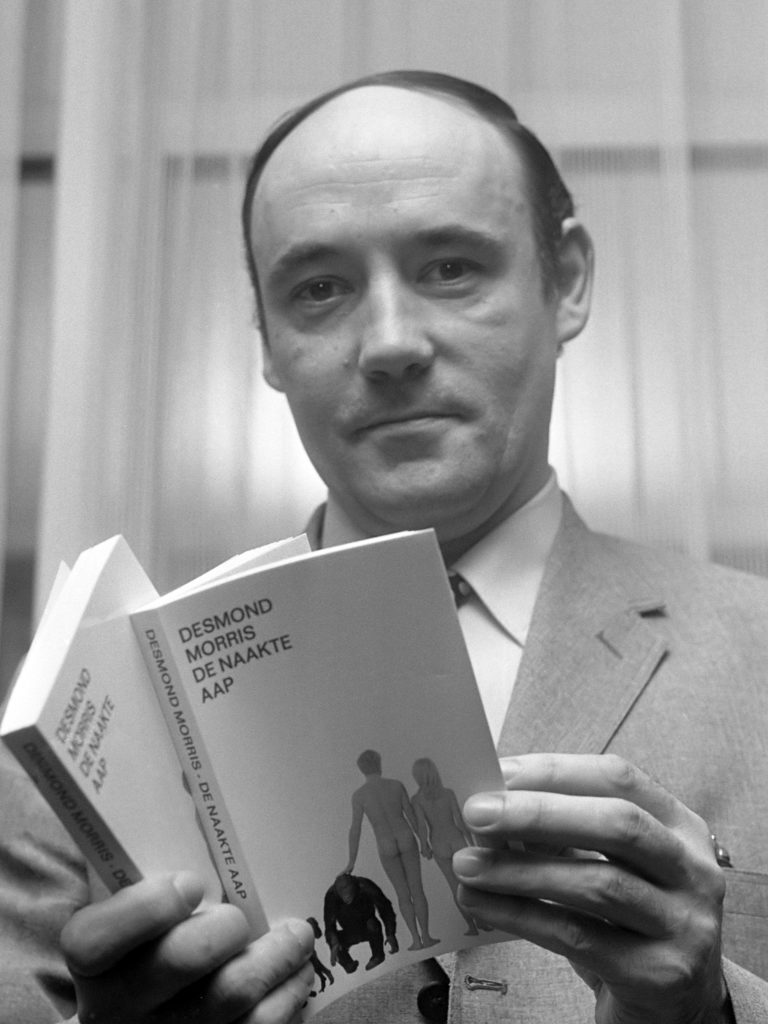
‘Morris pictured in 1969 with the Dutch paperback edition of his controversial and career-defining bestseller, The Naked Ape.
These provocative books on the human animal drew no shortage of sharp criticism from inside and outside the academy. Cultural anthropologists and some biologists rebuked Morris for reducing the complexity of human culture to crude analogies with animals, for overstating his evidence, and for reinforcing essentialist and regressive assumptions about sex, gender roles, and human nature. But Morris also won plaudits for his bold and imaginative claims, and for the attention he drew to ethology. Eager to revive academic affiliation, he returned to Oxford as a Research Fellow at Wolfson College (1973–81) and remained among the Dreaming Spires for the next forty-five years. Grants from the Guggenheim Foundation supported his research, including collaborative projects with colleagues in the Department of Experimental Psychology. His Gesture Maps Project yielded Manwatching (1977), another bestseller, and Gestures: Their Origins and Distribution (1979), after which Morris continued to work eclectically on topics that captured his interest. These ranged from football hooliganism (The Soccer Tribe, 1981), to feline behaviour (Catwatching, 1986), to The Nature of Happiness (2004), to The Lives of the Surrealists (2018). All the while he continued to paint and broadcast.
In 2014, Morris entrusted his scientific archive to the Museu de História Natural e da Ciência (Natural History and Science Museum) at the University of Porto, drawn by the institution’s commitment to making his archive the subject of ongoing research into human behaviour. It contains his Human Ethogram project, begun in 1970 with the ambition of compiling a comprehensive encyclopaedia of human gestures, postures, and expressions. Morris left Oxford after Ramona’s death in 2018 and moved to County Kildare, Ireland to live closer to his family. He is survived by his son Jason.