

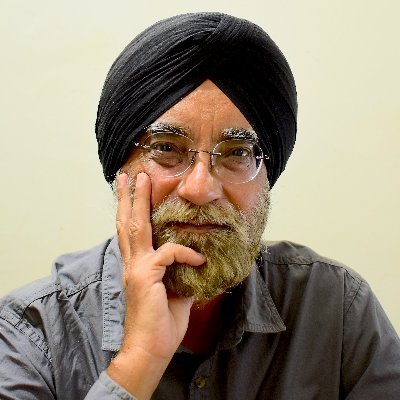
The 2026 MN Srinivas Lecture will be given by Professor Surinder S. Jodhka
This lecture is supported by the Royal Anthropological Institute
Tuesday 24 February 2026 18:00 – 19:00 (GMT)
The lecture will be followed by a wine reception.
Location: Nash Lecture Theatre (K2.31)
King’s Building, Strand Campus, London
To attend in person, register on Ticket Tailor
Reading Rampura, The Remembered Village, in the Time of Hindutva: Social Anthropology and the Making of the Indian Commonsense
Professor M. N. Srinivas pioneered the tradition of village studies in India during the 1950s. Although mostly authored by scholars trained in anthropology, the village monographs are widely regarded as the beginning of the tradition of empirical sociology in/of India, marking a shift from the orientalist and Indological ‘book-view’ to a ‘field-view’ of lived sociality.
‘Rampura’, a name he chose for presenting the village he studied to the broader profession, was not merely a rural settlement of a southern Indian princely state of Mysore; it was an ‘observation-centre’ for the study of the ‘traditional social structure’ of India, a representative sample of a country aspiring to become a modern nation-state. The village also embodied continuity with the country’s ancient past and its civilizational culture, ingrained in the Hindu ethos of hierarchy and caste-based divisions.
Srinivas was not alone. Village soon emerged as a standard methodological entry point to the study of Indian society. However, Srinivas’s The Remembered Village has perhaps been the most influential and popular text in this genre. Furthermore, some of his categories, such as the dominant caste, sanskritization, or vote-bank, have become part of Indian common sense and are widely used by popular media and in everyday narratives of electoral politics, mobility processes and the social structure of rural society. His scholarship has been foundational to the making of a textbook-view of India.
Though this textbook representation of India claims to be grounded in the ‘field’, it also reflects a preoccupation with the nationalist imaginations of his time, and later. For Srinivas, Rampura was not merely an empirical site, chosen for an ethnographic enquiry; it also represented ‘India in microcosm’, a society that is principally Hindu (Rampura?), and has a singular social structure marked by a specific (and unique) nature of tradition. Over the years, such a framing of Indian society has come to acquire a hegemonic position, a commonsense view of India’s traditional way of life and its authentic/original self.
Looking at it today, it may be interesting to ask how far such a textbook-view of India, grounded in the village studies carried out by social anthropologists during the 1950s and 1960s, differs from the ‘book-view’ of India that Srinivas criticised and against which he argued for a ‘field-view’. Several of his criticisms of the orientalist book-view of India could easily be invoked against the prevailing textbook view of ‘Indian society’. If the book-view of India was embedded with ideology, the textbook-view, too, carries a heavy burden of a different kind of ideology. Besides embedding the village in the framework of methodological nationalism, it also produces an exclusionary view of India.
Drawing on his own field studies of rural settlements across regions of north and northwest India, the speaker aims to demonstrate the limitations of the ‘book’–‘field’ binary. By doing so, he also seeks to underscore Srinivas’s central point that views of Indian society should not be constrained by the cultural preoccupations of a particular historical moment and the politics they embed. However, such a shift would also require learning from the parallel tradition of critical sociology, which foregrounds the need for a historical imagination in approaching the social as it presents itself in the field.
Surinder S. Jodhka worked as a Professor of Sociology at Jawaharlal Nehru University, New Delhi (retired in November 2025). He researches various dimensions of social inequalities, the dynamics of caste in contemporary India, agrarian change, rural India, and the political sociology of community identities. His recent publications include the Global Handbook of Inequality. Springer 2024 (co-edited). The Indian Village: Rural Lives in the 21st Century. Aleph 2023; The Oxford Handbook of Caste. OUP 2023 (coedited); India’s Villages in the 21st Century: Revisits and Revisions, OUP 2019 (coedited); Mapping the Elite: Power, Privilege and Inequality. OUP 2019 (coedited). A Handbook of Rural India. 2018 OBS (ed.). Caste in Contemporary India, Routledge, 2015; Caste: Oxford India Short Introductions, OUP, 2012. He is the editor of the Routledge India book series on ‘Religion and Citizenship’. He is the recipient of the ICSSR-Amartya Sen Award for Distinguished Social Scientists 2012 and the Malcolm Adiseshiah Award for Distinguished Contribution to Development Studies 2024.