
JRAI Special Issue Launch Event
Thursday 14th May 2026, 3.00 – 5.00 pm BST
This is an online event. Please register here for the Zoom link.
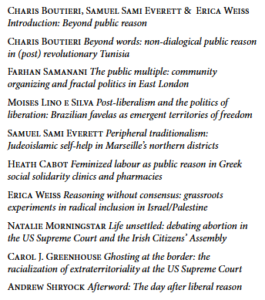
JRAI 2025 Special Issue: Beyond Public Reason
with editors:
Charis Boutieri (King’s College London)
Samuel Sami Everett (Universities of Southampton, Cambridge, & Aix-Marseille)
Erica Weiss (Tel Aviv University)
special issue contributors in attendance:
Farhan Samanani (King’s College London)
Moises Lino e Silva (The Federal University of Bahia)
Heath Cabot (University of Bergen)
Natalie Morningstar (University of Cambridge)
joined by: the chair of the RAI Publications Committee, Geoffrey Hughes (University of Exeter)
This special issue revisits the concept of liberal public reason, tracing its intellectual lineage from Enlightenment philosophy through Jürgen Habermas and John Rawls to its contemporary role in shaping political institutions and global governance. Long celebrated for its universalist aspirations, public reason has also been shown (particularly through anthropological inquiry) to rest on exclusions structured by culture, race, gender, class, and religion. The contributions gathered here interrogate how liberal public reason operates not only as a normative ideal but also as a hegemonic philosophy and pedagogical instrument, disseminated across transnational contexts as a model of rational, secular deliberation. At the same time, this issue moves beyond critique. The essays examine immanent social projects that enact alternative modes of public reasoning grounded in vernacular, embodied, and relational practices. Emerging both within and beyond liberal institutions, these projects articulate political horizons not fully determined by liberal assumptions. Rather than opposing liberalism to its presumed “illiberal” others, the authors illuminate diverse forms of deliberation – from community organizing and legal argumentation to spiritual claims and practices of solidarity – that reconfigure public reason as plural, situated, and responsive to deep difference without demanding assimilation to liberal norms.
Other contributing authors:
Carol J Greenhouse (Princeton University)
Andrew Shyrock (University of Michigan)
JRAI Associate Editor: Narmala Halstead (University of Sussex)
You can read the Special issue here (open access): https://rai.onlinelibrary.wiley.com/toc/14679655/2025/31/4
It is currently open access.
Contents: